The first few minutes with a ChomChom Roller can be surprisingly misleading.
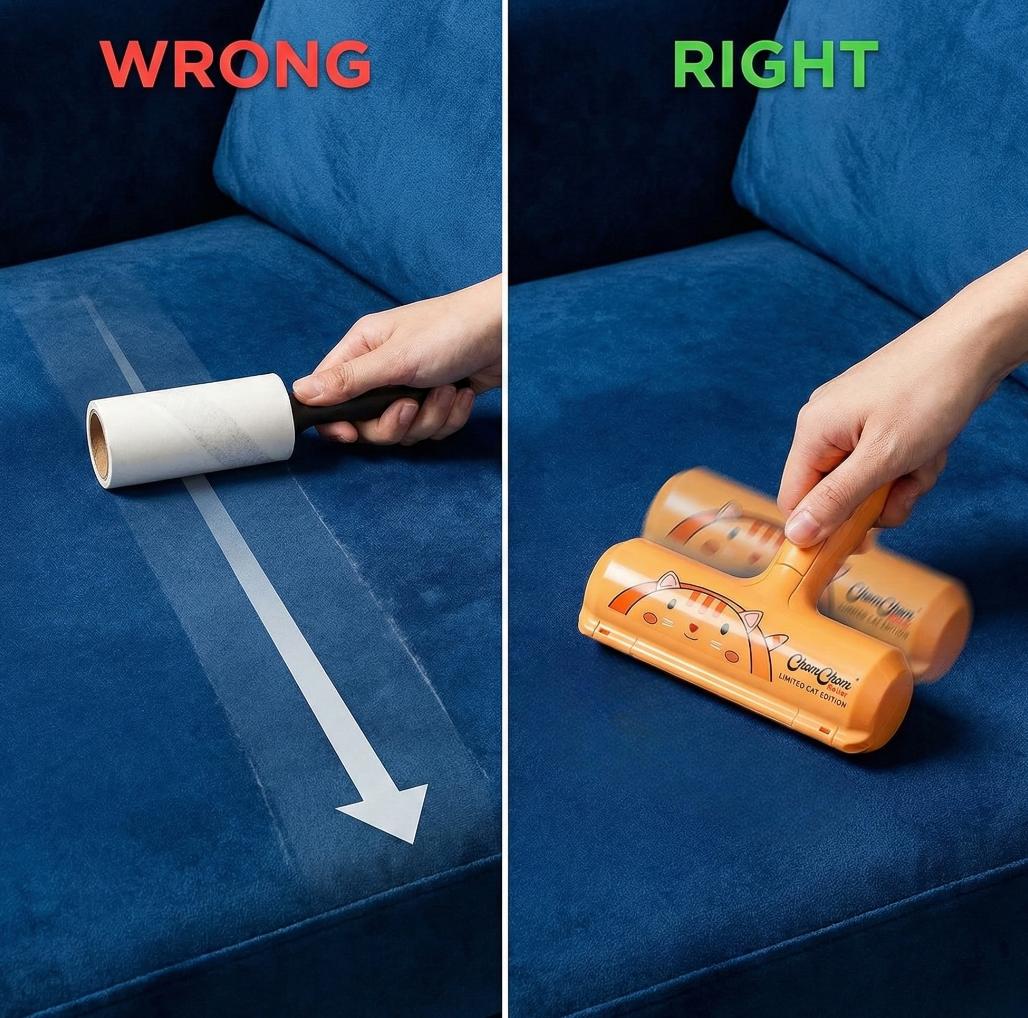
You take it out, run it across a hairy sofa the way you would use a normal lint roller, look down — and sometimes wonder what all the fuss is about.
Then you change one thing.
Instead of pushing it across the fabric in a long sweep, you start working the same area with short back-and-forth movements.
Suddenly the chamber begins filling with hair.
That difference is basically the whole trick.
The ChomChom is not difficult to use, but it does have its own rhythm. Once that rhythm feels natural, cleaning a sofa or pet bed becomes almost automatic. Until then, it is very easy to use the tool in a way that looks right but produces mediocre results.
Forget the Way You Use a Sticky Lint Roller
A disposable lint roller encourages one-way movement. You press the sticky surface against the fabric, roll forward, lift it, find a clean section of adhesive and repeat.
The ChomChom works differently. It needs the roller to change direction repeatedly.
Think less about “rolling across the sofa” and more about scrubbing a small area with controlled forward-and-back motion. Not aggressively. Not at high speed. Just: forward, back, forward, back.
The strokes do not need to be perfectly measured. On a sofa cushion, somewhere around the length of your hand often feels much more natural than trying to travel from one side of the cushion to the other in a single pass.
The important part is the reversal. That is also why the manufacturer’s instructions emphasize short, firm back-and-forth strokes rather than long movement in one direction.
Once you understand that, most of the ChomChom’s behavior starts making more sense.
What a Good ChomChom Stroke Feels Like
There is a surprisingly obvious difference between a stroke that is working and one that is not.
When the roller has good contact with the fabric, the movement feels controlled. You can feel a little resistance as you change direction, but the tool still moves freely.
If it is skating over the surface with almost no resistance, you may not have enough contact. If you are fighting the roller and forcing it across the fabric, you are probably pressing too hard.
The sweet spot is somewhere between the two. You should not need your body weight behind it.
On ordinary upholstery, moderate hand pressure is usually enough. Let the repeated motion do the work instead of trying to crush the roller into the sofa.
This matters even more on softer fabrics. Excessive pressure can bunch the material underneath the tool, and once the fabric starts moving with the roller, the stroke becomes less efficient anyway.
Start With the Easy Part of the Sofa
A flat sofa cushion is probably the best place to learn how the ChomChom behaves.
Do not begin with piping, corners or the narrow gap beside an armrest. Those are the most awkward parts of the job and can make the roller feel less capable than it really is.
Start in the middle of a seat cushion. Place the roller flat. Make several short passes over the same patch. Then look at the fabric.
You should be able to see fairly quickly whether the amount of loose hair is decreasing.
From there, move across the cushion in overlapping sections rather than randomly chasing individual hairs. This sounds like a small detail, but it makes the job faster.
A better rhythm is: clean one patch thoroughly → move over → clean the next.
Don't Fight the Direction of the Hair Forever
Pet hair does not always lie neatly in the same direction.
On a smooth sofa, this may barely matter. On textured upholstery, one set of strokes can remove most of the visible hair while leaving behind hairs that have settled into the weave at another angle.
When that happens, changing direction is often more useful than pressing harder.
If you have been working left to right, turn the roller and make a few passes vertically. Sometimes that is enough to pick up the stubborn layer that seemed invisible to the first set of strokes.
The goal is not to perform some exact crosshatch technique every time you clean. It is simply to recognize when repeating the same movement is no longer improving the surface.
When the result stops changing, change the angle before you increase the force.
Loose Fabric Is a Different Problem
A sofa cushion gives the roller something solid to work against. A loose blanket does not.
That is why people sometimes get a good result on upholstery and then feel as though the same roller suddenly became worse on bedding. Often the issue is not the hair. It is the fabric moving underneath the tool.
For blankets, comforters and removable covers, flatten the material first. If it shifts easily, hold one side with your free hand and create a little tension.
You are essentially giving the roller a firmer working surface.
Pet beds can have the same problem, particularly around soft sidewalls and corners. The flat sleeping area is normally straightforward. The floppy edges may need to be pulled taut or handled separately.
The Full-Size Roller Has a Physical Limit
The ChomChom is wide enough to make cleaning furniture reasonably quick. That same width becomes a disadvantage when the gap you are trying to clean is narrower than the tool.
If the roller has already cleaned the broad part of a cushion and there is a thin line of hair buried inside a deep seam, repeatedly attacking that seam with the corner of the ChomChom is not necessarily good technique.
Sometimes it is simply the wrong shape of tool.
The same issue appears in cars. The middle of a fabric seat can be a very good ChomChom surface. The narrow gap between the seat base and backrest is not.
Knowing when to stop using the ChomChom is part of using it properly. A good tool does not have to be the best tool for every square inch of the surface.
Car Seats Are Easier Than Car Carpets
Fabric car seats behave much more like furniture than carpet. You can work the center panel with normal short reversing strokes and make progress quickly on loose hair.
Automotive carpet is often a different story. Short pet hair can become deeply embedded between coarse fibres, especially after being stepped on repeatedly.
The ChomChom may collect the hair sitting on top while leaving the most stubborn strands behind. That does not automatically mean your technique is wrong.
There is a point where more passes simply stop producing a meaningful difference. When that happens, a more aggressive carpet tool or vacuum is usually the better next step.
Pressure Is Usually Overrated
When something does not come off a surface, the instinct is to push harder. With the ChomChom, that is rarely the first adjustment I would make.
Try changing the stroke length. Try changing direction. Make sure the roller is flat. Hold loose fabric tighter. Empty the chamber. Only then experiment with slightly firmer pressure.
The tool needs contact, but more force is not the same thing as more cleaning. Too much pressure can actually make the motion awkward because the roller no longer reverses smoothly.
And on delicate or unfamiliar upholstery, aggressive repeated rubbing is something worth avoiding anyway. If you are unsure about a fabric, test a hidden area first.
What Happens When the Chamber Fills Up?
One of the satisfying parts of using the ChomChom is opening the rear compartment and seeing how much hair has collected.
But the chamber is not decorative. If you are cleaning an area with heavy shedding, check it occasionally instead of waiting until the end of the entire job.
There is no prize for filling it as tightly as possible.
If the roller seemed effective when you started but gradually feels less productive, opening the compartment is an easy thing to check. Empty the hair, close it properly and continue.
If hair and lint have accumulated around the working parts themselves, that becomes a maintenance issue rather than a usage issue, and our How to Clean a ChomChom Roller guide covers that in more detail.
Clothing Requires a Lighter Touch
Can you use the full-size ChomChom on clothing? Sometimes, yes. Is it the surface where the large roller feels most natural? Not really.
A jacket or pair of trousers does not stay firm in the way a sofa cushion does. Sleeves, seams, collars and folds also create lots of awkward transitions for a wide roller.
If you do use it on clothes, laying the garment flat works better than trying to clean it while wearing it. Keep the fabric taut and shorten the stroke.
I would also use less pressure than on a sofa. And with anything delicate, loosely woven or prone to snagging, testing first is the sensible approach.
For removing three cat hairs from a shirt five minutes before leaving home, a small lint roller can still be the easier option.
The Most Common Sign You're Using It Wrong
The biggest clue is not that the ChomChom collects absolutely nothing. It is that it collects some hair, but much less than you expected.
This often happens when someone makes long forward passes with very little reversing motion. The roller is technically touching the hair, so a little gets picked up, but the technique never really settles into the movement the tool was designed around.
Before deciding that the ChomChom does not work on your sofa, try one simple comparison. Pick two similar hairy sections.
On the first section, use long one-direction passes. On the second, use short back-and-forth strokes.
You do not need a laboratory setup. The difference is often visible enough to tell you which movement suits that fabric better.
When the Roller Suddenly Seems Useless
If a ChomChom that normally works well suddenly stops collecting hair, there are a few things worth checking.
- Am I still reversing direction frequently?
- Is the roller sitting flat?
- Is the fabric moving underneath it?
- Is the collection chamber already packed with hair?
- Is the remaining hair deeply embedded rather than loose?
- Has lint built up around the roller surfaces?
- Am I trying to reach an area the full-size tool cannot physically contact?
That short diagnosis usually tells you more than simply increasing the number of passes. It also helps separate technique problems from surface limitations.
If loose dog hair is sitting visibly on top of a sofa and the roller is barely touching it, technique is worth investigating. If the last few hairs are trapped deep inside thick automotive carpet, the ChomChom may simply have reached the limit of what it is good at.
You Don't Need to Move Fast
There is no special ChomChom speed. A quick rhythm can be efficient once you are used to the tool, but speed itself is not what makes it work.
Control matters more. The roller should remain in contact with the material as it changes direction.
If you move so quickly that it bounces, tilts or barely touches the fabric, slowing down can actually make cleaning faster overall.
How Many Passes Is “Enough”?
There is no honest universal answer. Three passes might clean one sofa beautifully and barely change another.
Hair type matters. Fabric matters. The amount of shedding matters. How long the hair has been sitting there matters.
Instead of counting strokes, look at whether additional passes are still improving the area.
If each new pass is visibly removing more hair, keep going. If you have changed direction, checked the chamber and made several controlled passes but the remaining hairs are not moving, continuing indefinitely is probably not useful.
A fixed promise such as “five strokes removes all pet hair” sounds convenient, but real upholstery does not behave that consistently.
A Better Way to Clean a Whole Sofa
For a full sofa, I would not start in the middle and randomly move wherever the hair looks worst.
Use a simple order. Remove loose cushions if that makes them easier to handle. Clean each seat cushion completely. Then clean the back cushions. Then the arms and other broad upholstered sections. Leave seams, corners and awkward gaps until the end.
This separates the areas where the ChomChom is efficient from the areas where another tool may make more sense.
The Technique in One Sentence
If someone handed me a ChomChom for the first time and I could give only one instruction, it would be:
Keep it flat and work a small area with short, repeated back-and-forth strokes.
Everything else is adjustment. Use a little less pressure if the fabric bunches. Change angle if stubborn hairs remain. Hold loose material taut. Empty the chamber when necessary. Switch tools when the surface stops being a good match for the roller.
Final Takeaway
The ChomChom Roller does not require a complicated method, but it does reward the right movement.
Its biggest difference from a conventional lint roller is that you are not simply pushing it forward over the fabric. The repeated reversal — short forward stroke, short return stroke — is what you should get comfortable with first.
On firm upholstered surfaces, that technique is easy to learn and quick to repeat. On blankets and clothing, controlling the fabric becomes more important. On carpet, deep seams and tight corners, knowing the tool’s limitations matters as much as knowing how to move it.
Using a ChomChom correctly is not about pressing harder or following an exact number of passes. It is about noticing how the roller, the hair and the surface are behaving together — and adjusting before you waste time fighting the wrong problem.
For maintenance, see How to Clean a ChomChom Roller.
For the product’s strengths, weaknesses and best use cases, see our ChomChom Roller Review.
And if you want to understand why the direction change matters in the first place, our How the ChomChom Roller Works guide deals with the mechanism rather than repeating these usage instructions.
MyChomChom is an independent website and is not affiliated with or endorsed by ChomChom or its manufacturer. Some links on the site may be affiliate links, which means MyChomChom may receive a commission from qualifying purchases at no additional cost to the buyer.